F.I.L.M S.E.N.S.A.T.I.O.N
Planet Hong Kong: popular cinema and the art of entertainment., by David Bordwell In Planet Hong Kong David Bordwell trains virtually every critical weapon in the cinema studies arsenal on a film industry that has, ironically, been marginalized by its own popular success. Film scholars will be grateful for its theoretical breadth and acuity; film fans will be happy with the graceful way Bordwell weaves into his chapters an extraordinary amount of telling anecdote; and filmmakers will be thrilled with his wonderfully revealing frame-by-frame analyses of Hong Kong cinema's most exemplary moments.book review by Shelly Kraicerhttp://www.chinesecinemas.org/planethk.html
Wong Kar-wai: Auteur of Time by Stephen Teo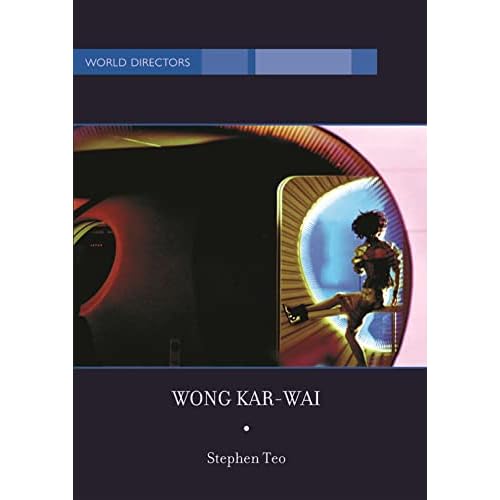 Book DescriptionThis, the first book-length study of Hong Kong cult director Wong Kar-wai, provides an overview of his career and in-depth analyses of his seven feature films to date. The study also takes an intriguing look at Wong's commercials for the likes of Motorola, BMW, and Lacoste and at his music video for DJ Shadow. Stephen Teo probes Wong's cinematic and literary influences--from Martin Scorsese and Alfred Hitchcock to Manuel Puig and Haruki Murakami--yet shows how Wong transcends them all. This comprehensive and thoroughly accessible study confirms Wong's position as the star of the Hong Kong-global nexus and as a postmodern exemplar of world cinema.
----------
In mah point of view, i reckon Teo provides very lil insight into wkw's aesthetic, he has figured out wkw in part because he understands the enigmatic director on so many stages/levels.Parts of warching movies is trying to figure them out on one level and then to try to catch other levels or layers on a second viewing. In the book, where Teo reads wkw as intensity 'local' and 'global', he suggests that wkw has brings up his iconoclastic; yet, teo explores wkw's work in HK culture as well as wkw's historial context. I reckon this is a book that really tell explored wkw's work, the way of working, and discuss his films in a way that is meaningful.
Things Wong Kar-wai Taught Me About Love* Requited love is an impossibility.*You will fall in love only once. Obstacles will prevail. The rest of your life is spent recovering.*Eroticising their possessions will be the pinnacle of your sexual fulfilment.*Anything that distracts you from the pain of your loss is good. Some people are more successful in this regard than others.*Hook up with someone. Live with them. Sleep with them. Tag along. Don't be fooled. You are only a transitory distraction. Ask for commitment. Declare your love. Watch the setup evaporate. *The most potent way to exist is to occupy someone else's imagination.*Desire is kept eternally alive by the impossibility of contact.*Modern communication enabling technologies will only heighten your sense of desolation by making you more keenly aware of the fact that no one is trying to call.
Collaborating with stock company (Chris Doyle, William Chang, Maggie Cheung, Tony Leung) and shooting haphazardly, in constant improvisational mode, Wong Kar-wai has brought to our cinema screens over the last ten years images of modern living, urban alienation, and forlorn love in a dazzlingly intimate, fluid, poetic and fragmented formal register. A call was recently put out for impressionistic contributions on any aspect of Wong's career: a single film, a particular character, a moment, a stylistic aspect, the way his work gets critically discussed, his key collaborators, his shooting style and so on. Each entry was required to centre upon, or use as a starting point, a one-word title. The final statements collected below range from the personal to the political, the deeply heartfelt to the bluntly critical.
Planet Hong Kong: Popular Cinema and the Art of Entertainment
Cambridge: Harvard University Press, 2000.' An effort to propose a poetics of popular film, while also celebrating a tradition I love. It’s also a mix of academic film history and film analysis with a looser, more informal writing style. Writing it was quite hard, since the subject kept changing from week to week: new films, a fresh crisis in the industry, another batch of books and articles, a new wave of information bursting off the Net. But I hope both fans and nonspecialists find some of it worthwhile. Other Hong Kong pieces are noted in the articles section.Translated into long form Chinese (Hong Kong: Arts Council Film Critics Society, 2001) and simplified Chinese (Beijing: Hainan, 2003). Italian readers might be interested in a journalistic essay, “Senza Inibizioni: Introduzione al cinema di Hong Kong,” Segno cinema no. 80 (July/ August 1996), pp. 12–14.
2046THAT ERA HAS GONENOTHING WILL EXIST AFTERWARDNOT EVEN ONCE


 WHY I LOVE::::::::::::::::::Wong Kar-Wai's film i reckon it is confused. Utterly, gloriously confused. It was 1997's Happy Together, about Chinese immigrants adrift in Buenos Aires; a rich, lovelorn odyssey shot both in colour and black and white. It left me bewildered and rather breathless. Not sure what I'd seen but thinking that it was brilliant anyway.
I think this is a typical reaction for most Wong Kar-Wai virgins. His films, from the hyper-real cop classic Chungking Express to his award-winning In the Mood for Love, often overload the senses; their moody, colour-saturated scenes and curious pace put the audience in a space of purposeful disorientation and heightened awareness. Not to say that they're deliberately obtuse or confusing. Rather then they're the kinda of films that benefit from repeat viewings. I can't guarantee that they will make any more sense the second time around but always they become more intriguing, carefully revealing the major themes of WKW's work - alienation, happiness, despair and the impossibility of love. These are the stories that unfold on their own unique terms, offering up the same ambiguities in real life. Stories to become entirely obsessed with.
Undoubtedly, Wong Kar-Wai is one of a kind. No other director takes such risks - as with Happy Together, he often works from the flimsiest of scripts - and no one has created such a beguiling visual language.
Working time and time again with the same team - including his director of photography Chris Doyle and actors such as HK superstars Tony Leung and Maggie Cheung - he's a man reaching closer and closer towards his creative peak.
film of wong kar wai wong kar wai is one of mah favourite director, since his films have been hypnotised by the beauty, vision and scop of his work, nah juz technically, but emotionally as well. There is a connection in all of his films,same characters have shown in different films, memories have always appear in his film, and i perceive and appreciate anything which might be called art and a furture design which reflect to the actual society.